
If your social feed is saturated with $400-a-night boutique hotels in Italy or elbow-to-elbow crowds around the Trevi Fountain, it is time to pivot east.
Something extraordinary is happening across Central Asia. For decades, the mythical Silk Road—the trading artery where caravanners traded silk, spices, and glass beneath turquoise-domed citadels—felt intimidating, bureaucratic, and logistically punishing. You needed hefty visa packets, letters of invitation, and hours spent choking on diesel fumes in dusty shared minivans.
Not anymore.
With 30-day visa-free access for over 90 nationalities, a Spanish-engineered 250 km/h bullet train slicing straight through the red desert, and daily ground costs averaging less than the price of a generic airport sandwich back home, Uzbekistan has become the most compelling budget adventure destination on earth.
Here is the complete, street-level 7-day blueprint covering Tashkent, Samarkand, and Bukhara: real schedules, exact train hacks, and the hole-in-the-wall choyxonas you won’t find in mainstream tour brochures.
The Reality Check: What 7 Days Actually Costs
Uzbekistan’s national currency, the Uzbek Som (UZS), trades in the millions. Walking out of an ATM makes you an instant millionaire, but your wallet will stay remarkably thick.
Total 7-Day Budget Per Traveler (Excluding international flights):
• True Backpacker: $210 – $280 total (~$30 – $40/day)
• Mid-Range Flashpacker: $420 – $550 total (~$60 – $80/day)
| Expense Item | Backpacker Cost (USD) | Mid-Range Cost (USD) | What You Get |
| Boutique Stay / Night | $12 – $18 | $40 – $65 | Traditional courtyard guesthouse with carved wood & breakfast |
| Main Meal (Plov/Shashlik) | $2.50 – $4.00 | $8.00 – $14.00 | Heaping plate of spiced lamb rice, salad, bread, and pot of green tea |
| Afrosiyob Train Leg | $9 – $14 | $18 – $26 | 250 km/h high-speed rail with reclining seats, tea, and air conditioning |
| Monument Admissions | $3 – $7 | $3 – $7 | Entry to UNESCO madrasahs, fortress walls, and minarets |
| Yandex City Taxis | $1.00 – $2.50 | $2.50 – $4.00 | Door-to-door rides across entire metropolitan districts |
The 7-Day Master Route: Fast Rails & Caravanserais
Day 1: Tashkent (Soviet Metro & Brutalism)
Day 2: Tashkent to Samarkand (The Plov Foundry & High-Speed Rail)
Day 3: Samarkand (Cobalt Domes & Timur’s Empire)
Day 4: Samarkand to Bukhara (Shah-i-Zinda & The Red Sand Crossing)
Day 5: Bukhara (Mudbrick Alleys & Kalyan Minaret)
Day 6: Bukhara (Emir’s Ark & Tea by Lyabi-Hauz)
Day 7: Bukhara to Tashkent (Return Express & Departure)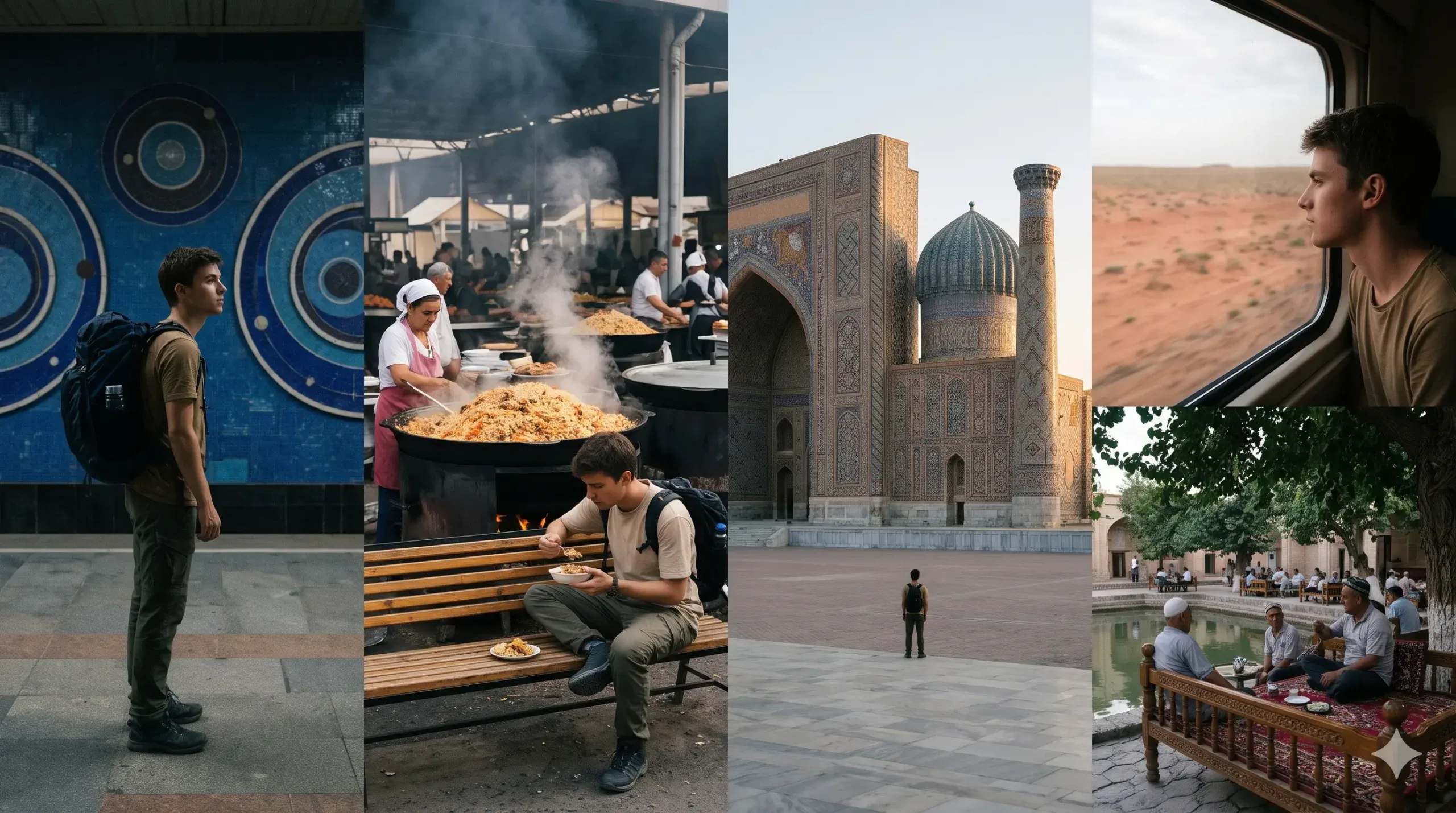
Day 1: Soviet Era & Subterranean Palaces in Tashkent
Most travelers treat Uzbekistan’s capital merely as an immigration checkpoint. That is a mistake. Tashkent is a fascinating, wide-boulevard collision of Soviet planning, leafy public parks, and historic Islamic resilience.
Morning: Descending into the Cold War Cathedrals
Tashkent’s metro system was engineered as a nuclear fallout shelter during the Cold War. Until recently, taking photographs inside was strictly illegal under military secrets legislation. Today, the ban is lifted, and each station functions as an underground art gallery.
Buy a magnetic token or tap your contactless debit card at the turnstile for 2,000 UZS (~$0.16). Ride the red Uzbekistan Line down to Kosmonavtlar Station, dedicated to Soviet space pioneers. The platform walls gradient from deep midnight blue to pale sky white, lined with ceramic medallions of Yuri Gagarin and Valentina Tereshkova glowing under orb fixtures.
Transfer to Alisher Navoi Station, where cavernous vaulted ceilings mimic Islamic domed cupolas inset with carved alabaster medallions.
Afternoon: The Sensory Overload of Chorsu Bazaar
Take the metro directly to Chorsu. As you emerge, the cityscape is dominated by an enormous turquoise-fluted concrete dome that looks like an inverted flying saucer.
Inside, the ground floor is dedicated to dairy: pyramid piles of dried salty yogurt balls (qurut) that nomadic horsemen carry for sustenance. Ascend the spiral ramp to the mezzanine for mountains of freshly cracked Fergana walnuts, dried yellow raisins, dried dried melons braided into sweet ropes, and dried mountain apricots.
Follow the plume of charcoal smoke outside to the Old City Grill Line. Squeeze onto a wooden bench and order two skewers of minced mutton lyulya kebab dusted with ground coriander and slivered raw onions. With a steaming wheel of sesame-stamped non fresh from the clay tandoor, your bill will rarely cross $3.00.
Sunset: The Concrete Giant
Stroll through Amir Timur Square as the evening light hits Hotel Uzbekistan. Built in 1974, this colossal, curving honeycomb monolith is the undisputed crown jewel of Soviet brutalist architecture. Grab a coffee at the outdoor kiosk across the road and watch the neon signage spark to life against the dusk sky.
Day 2: The Plov Cathedral & Shooting West to Samarkand
11:30 AM: Witnessing 500 Kilos of Rice at Besh Qozon
Before leaving the capital, make a mandatory pilgrimage to Besh Qozon (The Central Asian Plov Centre) near the Tashkent TV Tower.
Plov is not just a dish in Uzbekistan; it is an obsession, a social ritual, and a UNESCO intangible heritage asset. Do not arrive late: true plov masters (oshpaz) light their fires at dawn, and when the cauldron runs dry by 1:30 PM, service ends for the day.
Walk straight back to the open kitchen pavilion where cooks wield massive steel spatulas over kazans—cast-iron vats over two meters wide. Watch them layer lamb fat, tender chunks of beef, tender yellow carrots (sariq sabzi), chickpeas, and sweet barberries over bubbling broth and mountain rice. Order the “Wedding Plov” (To’y Oshi) topped with sliced horsemeat sausage (kazy) and hard-boiled quails’ eggs. It is rich, aromatic, and impossibly savory.
4:00 PM: Boarding the Afrosiyob
Hail a ride via the Yandex Go app to Tashkent North Station (Severny). Pass through station security, show your passport and e-ticket, and step onto the Afrosiyob—a customized Talgo 250 bullet train.
As the industrial outskirts of Tashkent fade into sweeping arid steppes, the train hits 230 km/h. Attendants pass through with complimentary hot green tea, biscuit packets, and wet wipes. In 2 hours and 15 minutes flat, you pull into Samarkand.
Check into a family-run guesthouse tucked inside the old Jewish Quarter, where traditional rooms wrap around open-air vine-covered interior courtyards.
Day 3: Cobalt Domes & the Shadow of Tamerlane
Samarkand was the heart of the world in the late 14th century. Emperor Timur (Tamerlane) consolidated the finest architects, ceramicists, and artisans captured from Damascus to Delhi to construct an imperial capital intended to humble the known world.
07:00 AM: The Registan Without the Crowds
Set your alarm for dawn. By mid-morning, the Registan is swarmed by organized tour groups, but at 7:00 AM, the central plaza is silent except for sweeping brooms and roosting swallows.
Stand in the center of the vast stone square framed on three sides by monumental madrasahs: Ulugh Beg (with its astronomical mosaic constellations), Sher-Dor (famous for defying orthodox iconoclasm by depicting roaring lions with rising suns on their backs), and Tilya-Kori (The Gilded One).
Step inside the mosque of Tilya-Kori. Look directly straight up at the dome. What appears to be an intensely ornate, high-domed vaulted ceiling is actually an elaborate optical illusion—a flat surface painted in trompe-l’œil gold leaf and lapis lazuli relief that forces your eyes into believing it recedes into infinite sky.
Afternoon: Gur-e-Amir (Timur’s Tomb)
Walk ten minutes down the pedestrian boulevard to the Gur-e-Amir. Beneath a double-domed ribbed cupola the color of a stormy sea lies the jade nephrite cenotaph of Timur. The interior walls are lined with carved onyx, gold leaf, and Quranic inscriptions.
Local Insight: When Soviet anthropologist Mikhail Gerasimov opened Timur’s tomb on June 20, 1941, he reportedly found an inscription inside: “Whomsoever opens this tomb shall unleash an invader more terrible than I.” Two days later, Nazi Germany launched Operation Barbarossa against the USSR. Timur was reburied with full honors in November 1942—shortly before the Soviet turnaround at Stalingrad. Coincidence or curse, the room carries an undeniable weight.
Day 4: The Avenue of Blue Tiles & Crossing into Bukhara
Morning: Walking Through the Afterlife at Shah-i-Zinda
No photograph prepares you for Shah-i-Zinda. This 11th-to-15th-century royal necropolis is a rising ceremonial staircase hemmed on both sides by 20 mausoleums clad entirely in majolica, terra cotta, and mosaic faience.
Every surface is covered in complex geometric starbursts, floral scrolls, and calligraphic bands rendered in turquoise, cobalt, teal, and saffron. Walk slowly through the narrow corridor early in the day as sunlight reflects off the glazed tiles, casting a deep turquoise hue over the stone paving.
Remember to dress respectfully: shoulders and knees fully covered, as this remains a revered pilgrimage site surrounding the shrine of Qusam ibn Abbas.
03:30 PM: Across the Desert to Bukhara
Hop on the afternoon Afrosiyob westward. The green irrigated valleys of the Zarafshan River gradually give way to the red sands of the Kyzylkum Desert. In 1 hour and 35 minutes, you step off at Kagan station, the railhead for Bukhara.
Bukhara is structurally the polar opposite of Samarkand. Where Samarkand was modernized with wide Soviet avenues separating its monuments, Bukhara’s old town is a living, breathing labyrinth of sun-baked mudbrick, covered trading domes, and dusty alleyways where locals still ride Soviet-era bicycles past 500-year-old wooden carved porticos.
Day 5: Minarets That Spared Genghis Khan & Medieval Trading Domes
Bukhara does not require taxis. Lace up comfortable walking shoes; the entire historic core is a UNESCO World Heritage site closed to through-traffic.
Morning: The Kalyan Minaret & Mosque
Start in the central plaza of the Po-i-Kalyan Complex. Rising 45.6 meters above the brick plaza is the Kalyan Minaret, an engineering marvel erected in 1127. Its baked brick exterior is wrapped in 14 distinct decorative bands, each laid in a unique geometric pattern.
When Genghis Khan rode into Bukhara in 1220, his horde destroyed the mosques, burned down the library, and flattened the town. But when he reached this plaza and looked upward, he was reportedly so awestruck by the sheer height and symmetry of the minaret that he ordered it spared. It has stood undamaged for 900 years.
Walk through the arched gateway across the square into Mir-i-Arab Madrasah, an elite Islamic academy that has operated almost continuously through Tsarist conquests and Soviet anti-religious campaigns.
Afternoon: The Ancient Bazaars
Wander through Bukhara’s interconnected 16th-century domed markets:
- Toqi Zargaron: The jeweler’s dome, where metalsmiths still hand-engrave silver bracelets and filigree earrings.
- Toqi Telpak Furushon: The cap-maker’s dome, stacked with sheepskin hats, embroidered skullcaps (tubeteika), and camel-wool scarves.
- Toqi Sarrofon: The ancient currency exchange dome over the canal.
Stop for lunch at a corner tea house for a bowl of Lagman—hand-pulled wheat noodles tossed in a rich broth of tender beef, sweet red peppers, garlic, and wild cumin, served with a dollop of sour cream and fresh dill. Cost: ~$2.50.
Day 6: The Ark of Bukhara, Chor Minor, & Sunset by the Pool
Morning: The Tyrant’s Fortress
Climb the sweeping cobblestone ramp to the Ark of Bukhara, a massive 5th-century earthen fortress resembling a walled city sitting on an artificial hill. This was the fortified palace of the Emirs of Bukhara, who ruled the region with absolute authority until Bolshevik artillery battered the mudbrick ramparts in 1920.
Walk through the coronation courtyard, inspect the royal reception halls, and step inside the museum documenting the eccentric, brutal history of the late Emirate—including the notorious “Bug Pit” where British officers Stoddart and Conolly were imprisoned during the height of the 19th-century “Great Game” rivalry between the British and Russian Empires.
Afternoon: Finding the Secret Gatehouse
Head deep into the dusty residential quarter east of Lyabi-Hauz to locate Chor Minor (Four Minarets). Built in 1807 by a wealthy merchant as the gatehouse for a now-vanished madrasah, this delightful structure features four turquoise-topped towers, each subtly decorated with symbols representing Christianity, Buddhism, Islam, and Zoroastrianism to illustrate the merchant’s philosophy of universal tolerance.
Evening: Mulberry Trees and Spiced Tea
End your day at Lyabi-Hauz, the historic public pool that has served as the social living room of Bukhara for centuries. Grab a low carpeted daybed (tapchan) beneath ancient mulberry trees planted in the 1400s.
Order a traditional porcelain pot of Kok-chay (green tea infused with star anise and crushed cardamom), accompanied by a wooden bowl of crystalline sugar cubes (navat) and roasted salted apricot kernels. As the desert night drops the temperature, locals gather to play backgammon and chat over steaming bowls of soup.
Day 7: Return Journey & Smart Transit
Morning: Express Train Back to Tashkent
Depending on your flight schedule, catch either the morning Afrosiyob or the fast conventional Sharq train back to Tashkent.
If taking the Sharq, you get wide, comfortable passenger carriages, a lively dining car serving tea and hot sausage rolls, and an authentic glimpse into how ordinary Uzbek families travel across the country with their luggage and market goods.
Final Tashkent Stop: Hazrati Imam
If your international departure is late in the evening, deposit your luggage at Tashkent Station’s storage locker and take a Yandex taxi to the Hazrati Imam Complex.
Housed in a small, climate-controlled library within the courtyard is the sacred Samarkand Kufic Quran (the Uthman Quran). Written on massive sheets of deerskin parchment in dark brown ink without modern vowel marks, it dates back to the mid-7th century and is believed by scholars to be one of the oldest surviving written records of the Quran in existence.
Head to Tashkent International Airport (TAS) for your flight home, with your passport stamped and memory cards full.
The Essential Logistics Survival Guide
1. The Afrosiyob Train Ticketing Hack
The high-speed rail is the backbone of this itinerary, but tickets sell out fast because domestic travel agencies purchase seats the moment they unlock.
- The Rule: Train tickets open exactly 45 days before the departure date at 00:00 local Uzbek time on the official portal (
eticket.railway.uz) and via the Uzrailway app. - The Action: Set a calendar alert 45 days out. Create an account, keep your passport number ready, and purchase your Tashkent-to-Samarkand and Samarkand-to-Bukhara tickets immediately.
- The Plan B: If the Afrosiyob is booked solid, do not panic. Book the Sharq or ordinary Soviet express trains. They take roughly 60 to 90 minutes longer, cost 40% less, and are remarkably punctual.
2. Money, Cards, and the Cash Reality
- Credit cards (Visa and Mastercard) work fine at major hotels and higher-end restaurants in Tashkent and Samarkand, but daily street vendors, bazaars, and entrance kiosks accept only cash.
- Carry a backup stack of clean, crisp US Dollars (unwrinkled $50 or $100 bills without stamps, tears, or pen marks). Exchange them at official bank counters or currency exchange kiosks at the airport and railway stations.
- ATMs are ubiquitous; Kapitalbank ATMs are the most reliable for foreign Visa/Mastercard withdrawals.
3. Registration Slips (Talon)
Whenever you check into a hotel or hostel in Uzbekistan, the front desk registers you with immigration authorities and hands you a stamped paper slip with a QR code (talon).
- Do not throw these away. Slip them into your passport sleeve. While airport immigration rarely checks every individual night for short stays nowadays, they still have the legal right to ask for your accommodations proof when you clear passport control upon departure.
4. SIM Cards & Apps
- Buy an Ucell or Beeline travel SIM at Tashkent Airport arrivals for roughly $6 (20–30 GB of data). The counter staff will register your phone’s IMEI number on the spot.
- Install Yandex Go immediately. It functions seamlessly, prevents overcharging from curbside drivers, and allows you to pay in cash or via saved international cards.
The Wanderer’s Verdict
Uzbekistan delivers what so many modern destinations have lost: genuine hospitality untainted by cynical commercialism, deep archaeological history you can touch without protective glass, and an ease of transit that makes independent backpacking a joy rather than a battle.
Pack light, bring a sturdy pair of walking shoes, and book that train before the rest of the travel world catches on.
Have you taken the Silk Road train, or are you piecing together your route through Central Asia? Drop your questions in the comments below, or head over to our Become a Wanderer community hub to submit your own local travel notes!